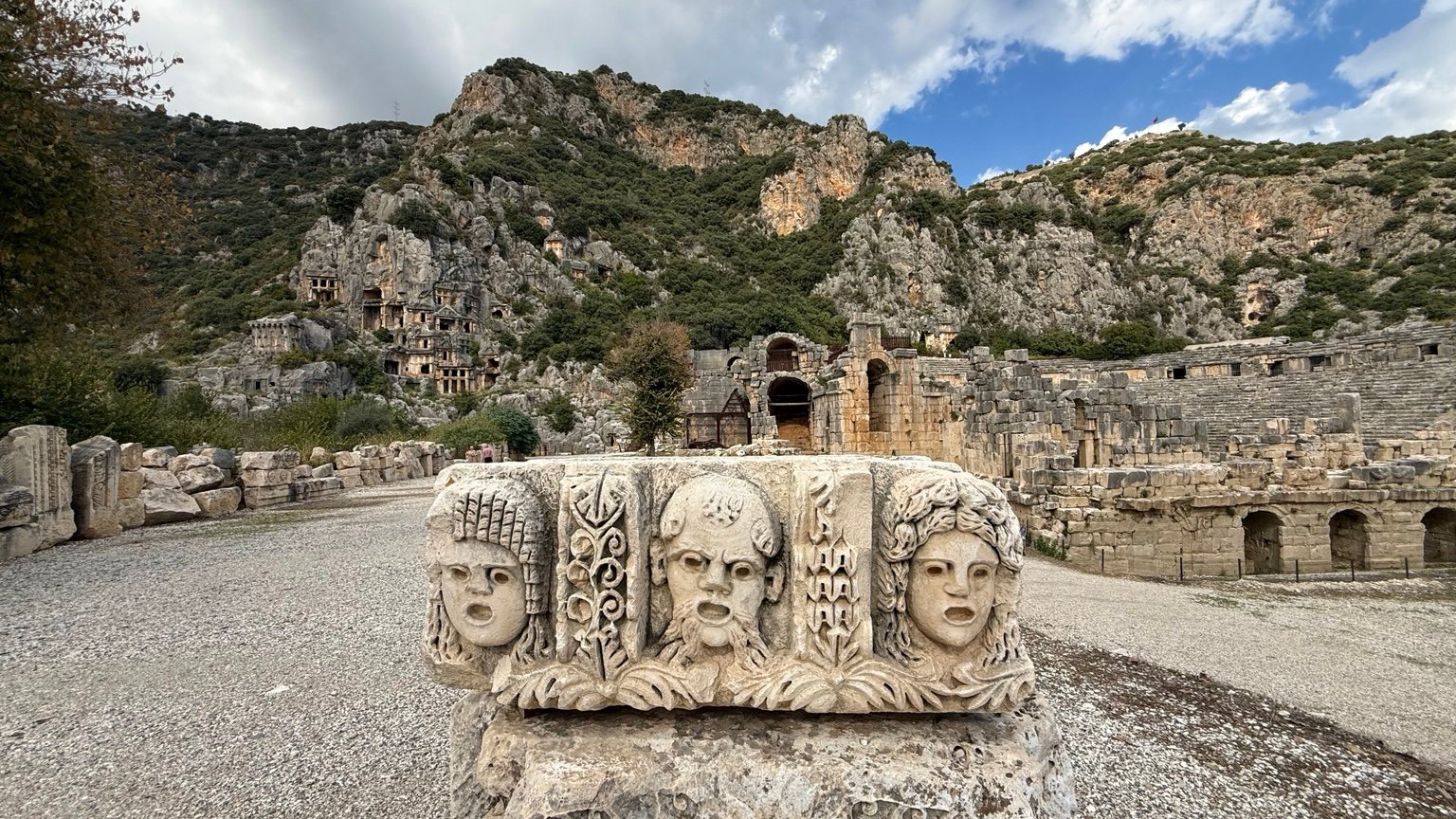
Demre should not be reduced to a single monument. The fullest picture emerges when you combine Myra, the ancient harbour of Andriake and the Church of St Nicholas. Together, they tell the story of a city, the sea, the early Christians and a man who, many centuries later, became the inspiration for the Santa Claus tradition.
At the ancient site of Myra, the Roman theatre stands beside a cliff of Lycian rock-cut tombs. Look for the carved stone masks near the theatre, like those in the cover photo.
Myra and St Nicholas
According to a centuries-old tradition, St Nicholas was born around AD 270 in Patara, and later made his life in Myra, where he became a bishop.
He became known for helping people in need and giving anonymously. Stories passed down over the centuries made him one of Christianity’s most venerated saints, and European traditions around St Nicholas are among the origins of the later figure known as Santa Claus.
The Church of St Nicholas in Demre
Nicholas was buried in Myra after his death. The site associated with his tomb became an important place of pilgrimage, and the Church of St Nicholas in modern-day Demre is one of the most significant Christian sites along this stretch of coast.
In 1087, sailors from Bari took a substantial part of the relics attributed to the saint from Myra and carried them to southern Italy. The Basilica of St Nicholas in Bari later became one of the most important centres of his veneration.
Myra in the New Testament
The Christian history of Myra begins earlier than the time of St Nicholas. Myra is mentioned in the Acts of the Apostles (27:5–6). St Paul, being taken as a prisoner to Rome, reached Myra in Lycia and was transferred there to an Alexandrian ship bound for Italy.
Nearby Patara also appears in the Acts of the Apostles. Both were important Lycian ports and part of a network of sea routes linking Anatolia with the wider Mediterranean world.
Andriake: the harbour of Myra
Andriake was Myra’s harbour. It helps explain the city’s importance: ancient Myra did not exist apart from the sea, but formed part of an active network of trade and travel.
Seeing Myra and Andriake together reveals two sides of the same centre: monumental rock-cut tombs and a theatre on the one hand, and an ancient harbour and maritime landscape on the other.
Planning a visit
It is best to treat Demre as a single historical route: Myra → the Church of St Nicholas → Andriake. The story then moves beyond one monument, from ancient Lycia and St Paul’s journeys to the tradition of St Nicholas.
To explore the beginning of that story, read our guide to Patara and Lycian history.
Andriake: the museum and an important visitor update
At Andriake you can explore remains of Myra’s ancient harbour, including the remarkable Roman granarium, a grain store dating to the reign of Emperor Hadrian. The building was adapted to house the Museum of Lycian Civilisations. That does not mean the displays are always accessible: the museum’s official website states that it has been closed since 17 February 2025 for exhibition and landscaping works, until those works are completed. Check its current status before travelling, and confirm separately whether the archaeological site itself can be visited.
Allow distinct stops for Myra’s rock-cut tombs and theatre, the Church of St Nicholas in Demre and Andriake’s harbour remains. They are separate places; do not assume a single ticket or set of opening hours covers all three.
Sources: official museum notice and Myra – Türkiye’s museum authority.